

Land intelligence · Development · Capital
Find the land. Build the opportunity.
LandBank uses proprietary software to identify and qualify land for solar, storage and strategic acquisition — then brings together the capital and delivery capability needed to take viable opportunities forward.
Free initial assessment · No obligation
Landowners
Explore your land’s potential.
Solar, storage or a long-term land agreement, starting with an evidence-led assessment.
Assess my landLand acquisition
A route to a considered sale.
Private and marketed farms, estates and strategic parcels across the UK and Ireland.
Submit an opportunityCapital & delivery partners
Bring the capability to progress.
Developers, capital providers and technical specialists with a clear mandate and delivery scope.
Partner with LandBank
Why have we contacted you?
Because your land
stood out.
Before making contact, LandBank Intelligence has already screened the opportunity against the factors that determine whether solar is worth investigating.
In plain terms, the screen asks six questions:
Enough land
Is there enough usable acreage to make a project worth exploring?
Solar potential
Does the location have the characteristics needed to generate effectively?
The ground
Are slope, terrain and flood risk workable?
Land quality
Could the right parcel be used without unnecessarily taking the best agricultural ground?
Planning
Are there obvious environmental or planning constraints?
The grid
Is there electricity infrastructure nearby that makes further investigation worthwhile? Nearby infrastructure does not confirm capacity.
Every opportunity is screened and scored before contact. Only those showing sufficient initial potential progress to outreach.
These are initial origination screens. They are not a formal grid offer, planning permission, a survey, legal or title due diligence, or engineering design. All of that is undertaken by appointed specialists, coordinated as part of the selected project route.
Passing this screen doesn’t mean a solar project is guaranteed. It means we’ve found enough evidence to believe a proper conversation is worthwhile.
Give the land another job
A different use. A considered decision.
For landowners considering solar, storage or a long-term income arrangement, the starting point is the land itself: what is genuinely available, what the evidence supports, and what you want to achieve.
01
A considered alternative land use
Suitable land may support solar or storage where agricultural, environmental and commercial evidence justifies further review.
02
More than one project route
A developer-led lease or option, an agreed landowner finance structure, or an outright sale may be appropriate. Funding and obligations depend on the route and final contracts.
03
The right parcel, not the whole holding
We look at a defined, genuinely available parcel. The rest of the farm carries on, subject to eventual access, cabling and project design.
04
Evidence before commitment
If the evidence does not stack up, we say so. There is no obligation to proceed.
For solar, the focus is grid-export generation rather than farmyard self-consumption. Any landowner income depends on the agreed rights, structure and project performance.
Landowner project routes
The right structure for the land.
There is no single funding or ownership model. LandBank coordinates the commercial route, bringing together selected capital and delivery partners where the evidence and terms support progression.
Route 01
Developer-led lease or option
The owner grants appropriate land rights. A selected developer or capital provider funds development and construction, subject to due diligence and final contracts. Rent, term, access and restoration obligations are agreed for the particular project.
Route 02
Landowner project / financed ownership
An ownership route may be considered only where a suitable finance structure is available and agreed. Economics, borrower obligations, security and ownership arrangements are project-specific, subject to partner appetite, underwriting and final contracts.
Route 03
Sale or acquisition
LandBank reviews farms, estates, strategic parcels and renewable-development land for outright sale or acquisition sourcing. Progress depends on buyer or investor mandate, due diligence and available capital; an assessment is not a purchase commitment.
Capital is not committed by an initial review. Landowners should take independent legal, tax and financial advice before agreeing land rights, borrowing or a sale. No route guarantees income, funding, planning or grid connection.
Land criteria
What makes a strong solar land opportunity?
Not every field should become a solar project. This is the filter, set out plainly, so you can form your own view before we speak.
Around five usable acres or more
Genuinely available acreage, not a nominal figure. Below roughly five acres, large-scale export solar rarely suits.
Checkpoint 1Level or gently sloping ground
A sensible field shape and workable access. Steep or broken terrain adds cost the scheme cannot always carry.
Checkpoint 2Constraints that can be managed
Floodplain land is a material constraint and usually rules a site out. Designations and land classification are screened early.
Checkpoint 3Useful access to three-phase grid infrastructure
Three-phase infrastructure on or close to the holding can materially strengthen an opportunity, particularly where extensive cabling is not required. Capacity and connection feasibility still have to be established for the individual project.
Checkpoint 4A route to the network that makes sense
The distance and the scheme size have to work together. We judge the grid evidence site by site rather than by a blanket distance rule.
Checkpoint 5A commercial structure that fits
Land rights, obligations and funding must fit the project. Financial standing and security are assessed where relevant to the selected structure; the landowner is not always the finance counterparty.
Checkpoint 6Clear authority to explore it
Someone with genuine authority over the land, and a real openness to a long-term use of it.
Checkpoint 7
If your land does not work, we will tell you quickly and plainly, and that will be the end of it.
Don’t know whether your land qualifies? That is exactly what the initial LandBank screen is for.
Indicative solar scale
Roughly what scale of solar could fit?
Enter the acreage you think might be available for an indicative technical capacity range. These are national rules of thumb for layout density only. A real LandBank assessment uses site-specific evidence rather than averages, and is an origination illustration rather than any form of quote.
Whole or decimal acreages are fine. A rough figure is enough at this stage.
Indicative capacity range
—
- Conservative — 4 acres per MW
- —
- Base — 3 acres per MW
- —
- High density — 2 acres per MW
- —
Site shape, grid, terrain and planning determine what is genuinely viable. These figures are indicative technical estimates based on typical layout density only.
Capacity is only half the picture.
What a site can generate depends on things a web page cannot know: the yield your own land records rather than a national average, where the nearest viable grid connection sits, and the shape and gradient of the fields.
Tell us where the land is and we will model yours on its own figures.
How it works
From evidence to a viable opportunity.
LandBank remains the commercial coordinator, from the first conversation through qualification, project route and partner selection to delivery or sale. Not every opportunity reaches every stage.
01
Discover
Proprietary software identifies private, off-market and marketed land and renewable opportunities across the UK and Ireland.
02
Verify
Check ownership and contact evidence, acreage and the initial land position. A conversation establishes interest and decision authority.
03
Screen
Review grid proximity and evidence, planning, flood, land quality, terrain, access and commercial fit. Screening is not approval or formal due diligence.
04
Secure
Agree an appropriate project route: assessment authority, heads of terms, option, exclusivity or acquisition arrangements, depending on the opportunity and legal advice.
05
Capital
Select potential capital and development partners, matching development equity, private credit, infrastructure capital, project finance or acquisition capital to the stage and structure.
06
Deliver
Coordinate technical and legal due diligence, planning, grid and design, then funding and EPC procurement where viable. Appointed planning, engineering, grid, ICP/HV, PPA and O&M specialists carry out their respective work.
07
Monetise
The agreed route may be to hold, lease, joint venture, sell land, sell development rights, sell a ready-to-build project or retain an interest. Each outcome depends on the project, capital and contracts.
Finance is subject to partner appetite, due diligence, underwriting and final contracts. Grid connection depends on network capacity, applications, DNO/TSO requirements and any appointed ICP. Construction and installation are carried out by appointed qualified contractors, not LandBank.
A second route for landowners
Considering selling land?
LandBank sources private, off-market and marketed farms, estates, agricultural land and strategic parcels across the UK and Ireland. Acquisition depends on buyer or investor fit, due diligence and available capital.
Why LandBank
Engineered for evidence-led origination.
LandBank is a sole-trader business built and operated by Sam Tuppen, a software engineer. He engineered LandBank Intelligence to turn fragmented land, ownership, grid and planning evidence into a ranked opportunity pipeline across the UK and Ireland. The proprietary software identifies, verifies, scores and manages records; it is the engine behind the business, not software for sale.
- 6,425
- screened records
- 25,984
- site-assessment records
- 6,425
- grid-evidence records
These are database record counts, not contracted opportunities or live deals. LandBank combines this evidence base with landowner engagement, early development management, capital matching and specialist procurement to coordinate viable opportunities through delivery or sale.
Straight answers
Common questions.
- Do solar panels work when it is cloudy?
- Yes. Panels generate from daylight, so they carry on working on overcast days. Output is lower than in strong, direct sunshine and varies with the season, which is why yield is modelled for each specific site rather than taken from a national average.
- How much land do I need?
- Around five acres of genuinely available land is the practical starting point. Larger parcels open up more options, but viability depends on the site rather than acreage alone.
- Will you use my whole farm?
- No. We look at the acreage that is potentially suitable and available. The focus is a defined parcel; access, cabling and any other requirements are dealt with through the final project design and agreement.
- Can sheep still graze around solar panels?
- Compatible agricultural use such as sheep grazing is often possible within a solar site, subject to the final project design and operating arrangements.
- Is there any benefit to wildlife?
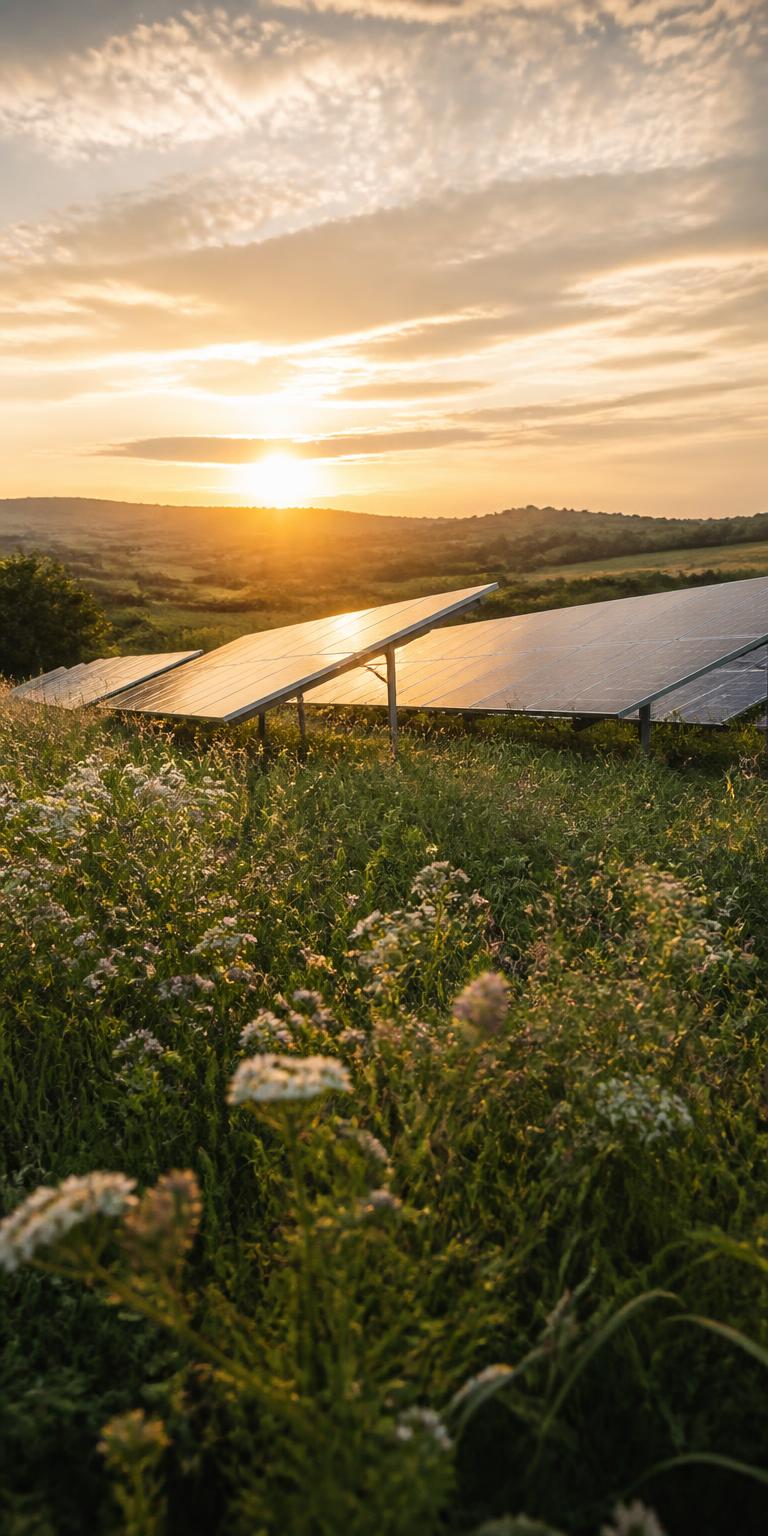
- Well-designed projects can create biodiversity and habitat opportunities alongside generation, subject to project-specific design and planning conditions.
- Does this mean taking prime farmland out of production?
- Not as a blanket approach. Agricultural Land Classification is screened at the origination stage. In England, national policy encourages lower-quality agricultural land to be preferred where agricultural land is needed for solar. Planning policy differs across UK and Ireland jurisdictions; appointed planning specialists assess each site.
- What happens to the land at the end of the project?
- Decommissioning and restoration obligations are dealt with in the eventual project agreement. They are matters to review with the project company and your own professional advisers.
- Does a good initial assessment guarantee a project?
- No. Our screening is an origination step. Formal grid application, planning, surveys and design, legal and title work and downstream due diligence all still follow, and a good number of sites are ruled out along the way.
- What is LandBank’s role after qualification?
- LandBank coordinates the commercial route, capital and development partner selection, due diligence and specialist procurement through delivery or sale where viable. Appointed third parties carry out technical, legal and regulated work, alongside your own advisers.
- Where do you work?
- LandBank identifies and progresses solar, storage and strategic acquisition opportunities across the United Kingdom and Ireland. Suitability depends on local evidence, policy and partner mandate.
Enquire
Let’s see whether the land stacks up.
Give us the postcode and approximate acreage. That is enough for an initial look. If the site is worth taking further, we’ll tell you. If it isn’t, we’ll tell you that too.
Sam Tuppen
Land origination & qualification
If you would rather talk it through first, call.